Wednesday, July 29, 2015

Corporate Politics - Good or Bad?

Often the phrase corporate politics leads to emotional reactions. It could be greeted with eye rolls or a sinking feeling inside your gut.

In the forthcoming book Corporate Bravery we spend a chapter on corporate politics and its role in creating a fear based culture. While there are many examples where corporate politics has gone wrong, I have created the embedded slide share to talk about how corporate politics doesn't have to be a culture killing practice.


I have embedded a slideshare below and I would love to hear your personal stories, feedback on the approach or other ways you have seen corporate politics play out in a good way. The comments section is below.


Wednesday, July 22, 2015

Jerk Bosses and Their Successes (or failure?)

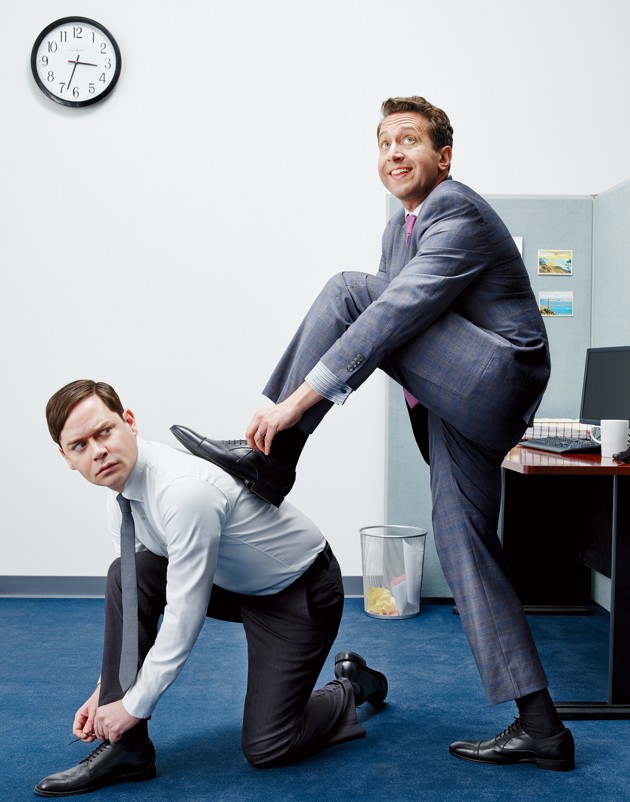
I recently came across one of my favorite news articles of the year in the Atlantic. The article, entitled "Why It Pays to Be a Jerk" is a long read and includes some great photos like the one below:


The article looks at scientific (and unscientific anecdotes) evidence regarding jerk-ish behavior - primarily in the workplace - and its impact on your ability to have success in the short and long-term.

This is relevant at Corporate Bravery because we spend a lot of time in the forthcoming book of the same name discussing bad managers' role in creating a culture of fear. Trust is at the heart of good managers and creating a culture that isn't fearful but brave in attacking new business opportunities and growing a long-term, sustainable business.

If that is so why does bad behavior that erodes trust persist in Corporate America? The article cites a few reasons. The first is embodied in the following quote.
But “to the extent that innovation and risk taking are in short supply in the corporate world”—an assertion few would contest—“narcissists are the ones who are going to step up to the plate.”

Grant argues that many takers are good at hiding their unpleasant side from potential benefactors—at “kissing up and kicking down,” as the saying goes. The article mentions a video series experiment where regular people were shown two different management styles to gauge their preference in managers.
And in a series of follow-up studies involving different pairs of videos, participants, responding to prompts, made statements such as “I would like this person as my boss” and “I would give this person a promotion.” The conditions had to be right, but when they were, rule breakers were more likely to be put in charge.
In fact, it’s easy to see how an initial advantage derived from a lack of self-awareness, or from a deliberate attempt to fake competence, or from a variety of other, similar heelish behaviors could become permanent. Once a hierarchy emerges, the literature shows, people tend to construct after-the-fact rationalizations about why those in charge should be in charge. Likewise, the experience of power leads people to exhibit yet more power-signaling behaviors (displaying aggressive body language, taking extra cookies from the common plate). And not least, it gives them a chance to practice their hand at advocating an agenda, directing a discussion, and recruiting allies—building genuine leadership skills that help legitimize and perpetuate their status. 
The commonality for most of the examples provided in the Atlantic article is a lack of trust.
Should something go wrong, jerks don’t have a reserve of goodwill to fall back on. The article tells the story of Howell Raines at the New York Times and how a scandal broke on his watch in 2003 when a Times reporter, Jayson Blair, had been fabricating material in his stories.
A town-hall meeting that was intended to clear the air around the scandal, during which Raines appeared before staff members to answer questions, turned into a popular uprising against his management style. “People feel less led than bullied,” said Joe Sexton, a deputy editor for the Metro section. “I believe at a deep level you guys have lost the confidence of many parts of the newsroom.” 
Raines himself had acknowledged as much earlier in the meeting. “You view me as inaccessible and arrogant,” he said. “Fear is a problem to such an extent, I was told, that editors are scared to bring me bad news.” It was an attempt to show he was a listener, Seth Mnookin reported in his book Hard News. But after listening to Sexton’s comments, Raines blew up. “Don’t demagogue me!” he shouted.
The article concludes - being a jerk will fail most people most of the time. Yet in at least three situations, a touch of jerkiness can be helpful.

1. leadership involves a series of onetime encounters

2. at the moment after a group has formed but its hierarchy has not.

3. when the group’s survival is in question, speed is essential, and a paralyzing existential doubt is in the air. (when fear is driving behavior)

Wednesday, July 1, 2015

Weekly Brave Roundup - Blackberry, Steve Kerr and Soundcloud


1. I am a sucker for a good sports analogy and this article about Steve Kerr and his leadership of the Golden State Warriors this year is a great read. Even the title of the article speaks to his fearless leadership of the team to a title - "The Risk-Taking General Who Led the Golden State Warriors to Victory".


The primary point of the article was a focus on his lineup decisions. Specifically the decision to move all-star and all-defensive veteran Andre Iguodala to the bench at the start of the season and then to scrap the lineup that had gotten Golden State to the championship round in favor of a smaller lineup.

The primary reason given for the last minute change was a suggestion by their video manager, a 28 year old that had been studying film. According to the article,
"So Kerr decided to wipe the blackboard clean, taking All-Defensive Second Team, rim-protecting center Andrew Bogut out of the rotation altogether, and going to an uber-small-ball unit anchored by the 6-6 undersized power forward Draymond Green. He also resuscitated David Lee, like Iguodala, another mothballed, highly paid former All-Star before Game 3, a ploy that kickstarted Steph Curry’s game in the midst of what ended up being a failed comeback effort.
Considering the stakes, this was a downright radical move on Kerr’s part, and one that easily could have blown up in his face."
As the article points out, it is unique that an NBA coach (or any business executive) would listen to an entry-level employee over the high paid executives and assistants.
"Outside of Gregg Popovich’s Spurs, this just doesn’t happen. Video assistants don’t get to pitch the man in charge, let alone get the credit, and the vast majority of head coaches are far too small-c conservative and risk-averse to even contemplate such a move, let alone admit that he lied about it."
But that single decision isn't the thing that ultimately made Steve Kerr a great leader, a championship leader. Rather it was the culture and the tone that he set before the season even began. He created a culture that made it not only OK to accept a lesser role for the good of the team, but even encouraged it.
Kerr demanded that they have fun. That in and of itself is revolutionary. More to the point, he was willing to speak to his players not like soldiers or faceless office drones, but like... well, people that he trusted and legitimately liked. That’s why Iguodala bought in early on, and Andrew Bogut and David Lee did the same.


2. I was able to recently read an excerpt from a new book about Blackberry entitled "Losing the Signal: The Untold Story Behind the Extraordinary Rise and Spectacular Fall of Blackberry."


The book looks to be an extraordinary read about the fall of a high-tech highflier and the individual decisions that led them to a struggle for survival.

Wednesday, June 24, 2015

Weekly Fearful Roundup

This week we feature two excellent examples of how fear can and has been used both in the public domain and in business.

1. The first example is the tussle between startup Benefits and ADP. By way of background, Zenefits is attempting to shake-up a sleepy industry for HR, Payroll & Benefits software. While most think of ADP as being a payroll company they have become a dominant force in HR and benefits as a result of the relationships they have in corporations big and small.


Zenefits relies on ADP for Payroll to provide a full service technology suite to HR organizations and recently ADP turned off access to ADP technology that is publicly available to other accounting and small technology providers.

Zenefits was not content to sit back and let this happen and after trying to resolve the issue they went on the offensive which is documented in this blog post. The campaign was complete with a hashtag, a petition.org account and targeted media coverage.

One of the statements that stood out to me in the blog post includes this quote that is all to familiar to us at Corporate Bravery:
"we believe ADP is using a tried and true tactic in enterprise software: whenever a new, innovative company enters a market, the incumbent tries to spread fear, uncertainty and doubt about the new market entrant. This tactic is so common it even has an acronym—FUD (Fear, Uncertainty, & Doubt)."

Wednesday, June 10, 2015

Weekly Roundup - Auditors, Regulation & Disney

This week's roundup doesn't really include any brave examples, rather some recent stories that represent some common themes from my upcoming book on Corporate Bravery.


1. The May 2015 issue of Fast Company profile's Disney's attempt to completely reinvent the guest experience at their theme parks. The initiative was 'green lit' in February 2011 and was centered around the use of technology, specifically the park wristbands as a part of the MyMagic+ project.

The project started out as a grand vision of using the wrist band to not only get a fast pass to the best rides but create a digital infrastructure that allowed all park employees to create a tailored experience for each individual guest. However after many setbacks along the way it has found only limited usage and primarily as to buy things at the park.

The article chronicles the political struggles inside Disney that challenged the project's original vision and has ultimately prevented the project team from getting the types of ROI that were possible. Some of the quotes from the article that highlight these political struggles include:
"Franklin managed to get some teams to collaborate well on the project, but most describe the internal politics as fierce."
"Other divisions expressed themselves passive-aggressively. "They might see a problem coming, but they don't do anything about it, like, 'Let them figure it out!' says a former Disney manager. 'Then, late in the game, these folks came in going. We knew this was going to be a problem.' We were like Really? Where have you been for the last three and a half years?!?"
"The endless finger pointing and glory hogging slowed the ambitious project. "Almost half the work was to support a political situation," says one executive at an NGE partner company. "At the beginning, we could move really rapidly, but when it got public within Disney, it changed the way we worked. It became more about fighting to survive another day."
Reading these quotes bring to mind my experiences as a business sponsor for a large multi-year, multi-million $ project that I lead a few years ago. I am sure my experiences and Disney's are not isolated examples and the role that politics plays in creating an organization that is driven by fear is universal.

Thursday, June 4, 2015

Weekly Brave Update - Chip Kelly, Campbell's Soup Edition

This week I am focused on examples of brave leadership in two industries that nearly all of us have experiences with - food and football.


First lets start with Chip Kelly & the Philadelphia Eagles. There was a great story this past week in Sports Illustrated about Chip's overhaul of the Eagles. While the jury is still out on the effectiveness of his complete overhaul of the team - one thing that is confirmed is Chip's bravery. In fact the title of the article is "Chip Kelly's fearless coaching mind."

Despite presiding over arguably two successful seasons that culminated in 10-6 records, he went 'all in' on his vision for success this past offseason. He let walk or traded his top 3 offensive weapons, including his starting quarterback, and made some big name free agent signings. Listening to sports talk radio during the free agency period you would think that everyone was bi-polar based on the daily reactions to Chip's moves.

You might be thinking 'why are we talking about sports on a business blog?' but coaching an organization like the Eagles is as complicated as being the CEO of any Fortune 500 company and we can find some strong lessons in Chip's mindset toward fearless management.
"Either Kelly is a forward-thinking genius, in the mold of Bill Walsh, Jimmy Johnson and Bill Belichick—or he’s just another coach who never should have left the college ranks. Whichever it is, the word bold doesn’t begin to define the transformation that Kelly has put his team through this off-season, his second since jumping from Oregon to the NFL."
Part of what makes his moves so bold is the fact that he has a very clear vision for his team and is confident in knowing the types of personnel he needs in that system to be successful.
“Certainly he has his strategy and the way he wants to build his team,” says Stephen Jones, executive vice president of the Cowboys. “You’ve got to respect him for that. He seems very convicted in how he wants to do his roster.” At every position he knows exactly what type of player he wants, from physical description to mental makeup."
This vision and understanding of who the organization is and complementing that with the right personnel is the hallmark of a truly brave organization. Another key aspect of corporate cultures that operate in a brave way instead of out of fear is that they are not easily influenced by the media. Despite a preponderance of critics of these moves Chip has been undaunted. Not in a way that is stubborn but in a way the conveys confidence in his strategy and what he wants to accomplish. According to the article,
"It’s impossible to say whether Kelly’s method will thrive long-term in the NFL, but he’s made all the right moves at every level of his career while naysayers shook their heads and said, That’s not the way things are done. He sets his own course and, so far, it’s been one that everyone else ends up following."

Secondly, there was a great in-depth look at the rapidly evolving US food industry in Fortune Magazine. The article provides a great summary of the wrenching changes that are accelerating in the way Americans buy food that is having massive implications on how food is grown, processed, marketed and sold.